
If the idea of having people identified because of their beliefs (and in order to better persecute them) is certainly horrendous, there is still something I do not understand:
- A lot of justified outrage at the news that in Iran Christians, Jews and Zoroastrians will soon have to identify themselves with a specific coloured cloth (subsequently denied);
- Silence when the UN discloses Ayatollah Khamenei's order to the Ministry of Information, the Revolutionary Guard and the Police Force to identify of all the members of the Baha'i faith.
?
Saturday, May 20, 2006


Thursday, May 18, 2006
On the fringe of "the letter"
Much has been said about "the letter". I would like to mention two: Firstly, an interesting point at the end of a New York Times article that quoted Wahid Abdel Maguid of the Egyptian Al Ahram Center for Political and Strategic Studies, saying that the letter "was addressed more to young people in the Islamic world than to the American president" (this point was subsequently repeated by others). And there was also a much-needed response to the missive, posted on a blog, which brought everything back into the right perspective.
Reading the letter, I could not but notice the amount of "(PBUH)" it contained, associated to the various prophets mentioned. Of course, Muslims are familiar with the letters in brackets that always appear after Prophet Mohammed's name, but I was wondering what Americans, and Westerners in general, would make of it.
This led me to another, perhaps more fundamental reflection: one of Mr. Ahmadinejad's points in the letter was to show his own piety and somehow prove that not only was he a fervent believer in Prophet Mohammed, but he was also knowledgeable about and respectful of the Teachings of Christ -- a claim Mr. Bush seemed to make but not put into practice. However, if one reveres the Divine Messengers, then it could indeed be a form of respect to follow the utterance of their names by the expression of the wish that peace be upon them. But then reduce this to a few letters in bracket? To me, this kills all reverence, piety and spirituality.
Reading the letter, I could not but notice the amount of "(PBUH)" it contained, associated to the various prophets mentioned. Of course, Muslims are familiar with the letters in brackets that always appear after Prophet Mohammed's name, but I was wondering what Americans, and Westerners in general, would make of it.
This led me to another, perhaps more fundamental reflection: one of Mr. Ahmadinejad's points in the letter was to show his own piety and somehow prove that not only was he a fervent believer in Prophet Mohammed, but he was also knowledgeable about and respectful of the Teachings of Christ -- a claim Mr. Bush seemed to make but not put into practice. However, if one reveres the Divine Messengers, then it could indeed be a form of respect to follow the utterance of their names by the expression of the wish that peace be upon them. But then reduce this to a few letters in bracket? To me, this kills all reverence, piety and spirituality.
Tuesday, May 09, 2006
Football and populism
The strategy involved various entities in power and the orchestration was smooth: Mr. Ahmadinejad played the card of women's rights by announcing that he was allowing indiscriminate access to football stadiums, then a number of grand Ayatollahs publicly expressed their disapproval (one of them being the President's own mentor) and finally the Leader himself said that it was inappropriate and the President bowed to Ayatollah Khamenei's wish, of course. Back to square one, with a few popular gains.
A few days ago I came across an article about a talk given by Ramin Jahanbegloo at the Amir Kabir University some months ago (unfortunately it is in Persian). During the talk Mr. Jahanbegloo made reference to the present government by calling them "populists" and in response to a question on the present situation in Iran he cited Jean-Paul Sartre saying France was never as free as during the Vichy regime. Later in the presentation, he went on to strongly criticize the Reformists as well, saying that the Populists appeared in our society because people no longer trusted the Reformists...
No wonder the man is now in Evin.
A few days ago I came across an article about a talk given by Ramin Jahanbegloo at the Amir Kabir University some months ago (unfortunately it is in Persian). During the talk Mr. Jahanbegloo made reference to the present government by calling them "populists" and in response to a question on the present situation in Iran he cited Jean-Paul Sartre saying France was never as free as during the Vichy regime. Later in the presentation, he went on to strongly criticize the Reformists as well, saying that the Populists appeared in our society because people no longer trusted the Reformists...
No wonder the man is now in Evin.
Saturday, May 06, 2006
Countdown
No, I am not going to talk about the nuclear issue nor the Security Council but just return to my favourite subject: human rights.
Elections to the Human Rights Council are going to take place next Tuesday, 9 June, and as I have previously mentioned Iran is a candidate, although by now I believe it will not make it: there are enough other candidates within the Asian group with either better human rights records (which is not so difficult to achieve, as we all know) or who are more powerful and therefore can secure the votes regardless.
But predictions is not the purpose of this post. Because of this candidature, Iran has had to make commitments to the promotion and protection of human rights standards. The letter speaks for itself, but allow me to indulge in quoting one paragraph:
"The IRI, if elected, will spare no effort to assist the international community to safeguard the HRC from injustice, double-standards and politicization."
In other words, it will do its utmost to prevent Iran from being condemned for its human rights violations, as we can see from this and this, just to mention a couple.
On their websites, Human Rights Watch and Amnesty International have analyzed the situation of the various candidates. Iran is worth checking... edifying!
Elections to the Human Rights Council are going to take place next Tuesday, 9 June, and as I have previously mentioned Iran is a candidate, although by now I believe it will not make it: there are enough other candidates within the Asian group with either better human rights records (which is not so difficult to achieve, as we all know) or who are more powerful and therefore can secure the votes regardless.
But predictions is not the purpose of this post. Because of this candidature, Iran has had to make commitments to the promotion and protection of human rights standards. The letter speaks for itself, but allow me to indulge in quoting one paragraph:
"The IRI, if elected, will spare no effort to assist the international community to safeguard the HRC from injustice, double-standards and politicization."
In other words, it will do its utmost to prevent Iran from being condemned for its human rights violations, as we can see from this and this, just to mention a couple.
On their websites, Human Rights Watch and Amnesty International have analyzed the situation of the various candidates. Iran is worth checking... edifying!
Wednesday, May 03, 2006
(double) Standards
A while ago, another blogger wrote about double standards, or more precisely about various interpretations depending on what suits the argument. His was in favour of the IRI. The discourse was so "nonsensical" (to use the terms of someone who responded in the comments) that my disappointment with the author led me to stop reading the blog altogether, rather than responding.
But the malaise of not having expressed my frustration remained, I guess (although I gladly found today that, in fact, someone did.)
And then, here I am, thanks to Mr. Zarif who had another go at the UN. Surely, he must feel a little awkward at calling upon the United Nations Security Council to somehow protect Iran when, a day or two before, his President had indicated that "Iran does not give a damn about such [Security Council] resolutions", and his main nuclear negotiator had defined them as "not very important".
But the malaise of not having expressed my frustration remained, I guess (although I gladly found today that, in fact, someone did.)
And then, here I am, thanks to Mr. Zarif who had another go at the UN. Surely, he must feel a little awkward at calling upon the United Nations Security Council to somehow protect Iran when, a day or two before, his President had indicated that "Iran does not give a damn about such [Security Council] resolutions", and his main nuclear negotiator had defined them as "not very important".
Saturday, April 29, 2006
O.I.D.
A couple of bloggers have recently referred to the obsession about our inalienable right (OID) that has turned into jokes, the best one so far is here, and a number of them are here.
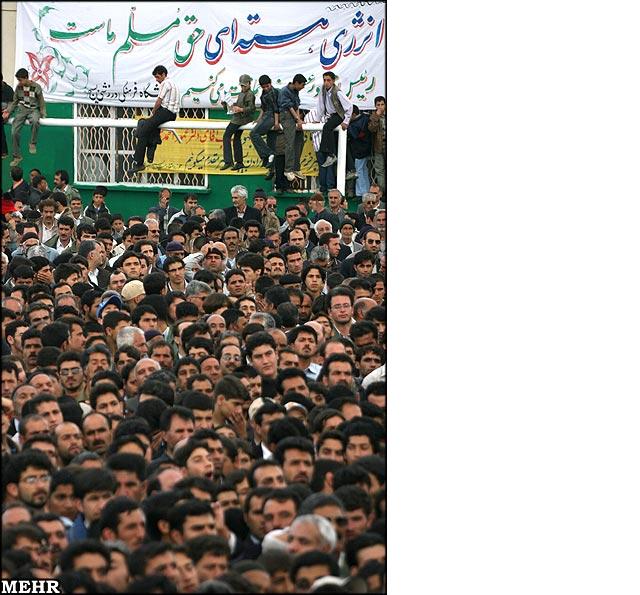
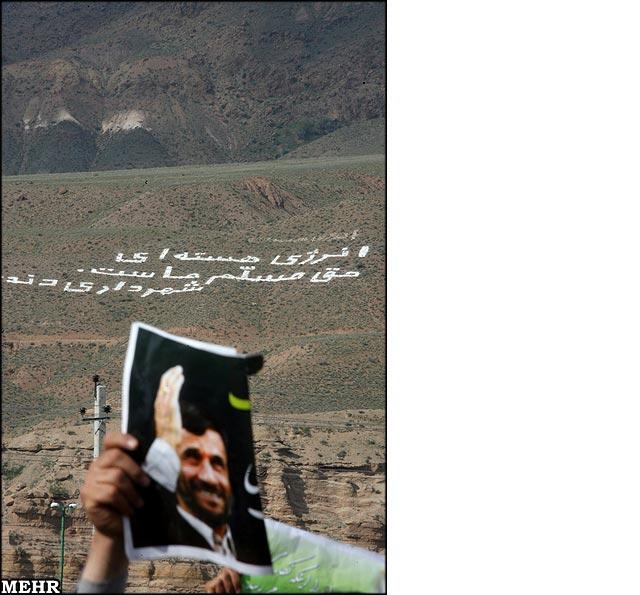
So I thought I should add a few photos I saw yesterday, on Mr. Ahmadinejad's visit to Zanjan:
Starts with a banner, saying OID:

Then on the hills:

Then it goes a little further, as these children are saying: "An independent representative (added: to the Majlis) is OID

So I thought I should add a few photos I saw yesterday, on Mr. Ahmadinejad's visit to Zanjan:
Starts with a banner, saying OID:
Then on the hills:
Then it goes a little further, as these children are saying: "An independent representative (added: to the Majlis) is OID
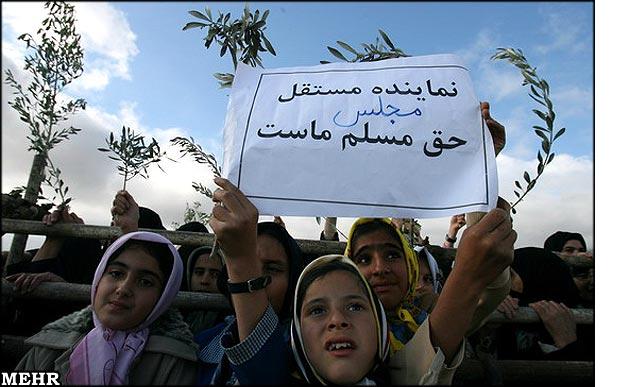
Of course, the best and funniest (and earliest) is here.
Wednesday, April 26, 2006
Douste, my friend
For the past year now, France, and particularly its Minister of Foreign Affairs, have taken a pretty strong stance on Iran. Very different from the wishy-washiness we had previously seen from them and in stark contrast with the position they held on Iraq.
The interview given to Rooz (the original French is here) is interesting because it is coming from a country that is "highly regarded" in Iran. Furthermore, Philippe Douste-Blazy himself stated that he chose the Internet media because they "have a very large audience in your country" and then went on to try to dispel some of the misinformation that is spread in the country about our "inalienable right"
And then Mr. Douste-Blazy clearly indicated that France's economic interests will not prevent it from being at the forefront of the promotion of human rights in Iran. One might be sceptical, hoping that the interview is not only lip service and that this and this will not take precedence over human rights concerns.
Let's say I have a soft spot for good-looking French doctors. However, one must admit that Douste is doing far better than one of his predecessors who, in a Op/Ed on Iran published today, together with other former FMs, indicated having "met with influential Iranian officials during the past few months" but did not even care to mention human rights...
The interview given to Rooz (the original French is here) is interesting because it is coming from a country that is "highly regarded" in Iran. Furthermore, Philippe Douste-Blazy himself stated that he chose the Internet media because they "have a very large audience in your country" and then went on to try to dispel some of the misinformation that is spread in the country about our "inalienable right"
And then Mr. Douste-Blazy clearly indicated that France's economic interests will not prevent it from being at the forefront of the promotion of human rights in Iran. One might be sceptical, hoping that the interview is not only lip service and that this and this will not take precedence over human rights concerns.
Let's say I have a soft spot for good-looking French doctors. However, one must admit that Douste is doing far better than one of his predecessors who, in a Op/Ed on Iran published today, together with other former FMs, indicated having "met with influential Iranian officials during the past few months" but did not even care to mention human rights...
Thursday, April 20, 2006
I'll be there when you get there
I finally got round to reading Mohsen Sazegara's Policy Focus, published by the Washington Institute for Near East Policy.
Mr. Sazegara's main point is that Iran is moving towards democracy, inevitably. Well, given that he does not give any time frame, I guess we can all agree with him: it will happen, eventually.
I found the piece more descriptive than analytical, and had hoped for a little more “meat”:
For example, Mr. Sazegara lists the various existing Iranian political groups; but of course, aside from the Islamists, they are all outside Iran. It would have been interesting to know how much support he thinks each of them have inside the country. (To his credit on this, he does not make any difference between the Islamists, so none of that Reformists-versus-Conservatives business. In fact, he writes that despite the liberalist slogans of some, none of them have cooperated with non-Islamist groups and that they have either kept quiet or even joined in when non-Islamists have been suppressed.)
And then he does not speak of the lethargy that has engulfed the country, or rather, he dedicates one sentence to it, and says that it will come to pass. Again, no time frame, and a little too much optimism.
Finally, although he mentions, as he should -- he is one of the persons behind the referendum after all, that no real change can take place within the framework of the actual Constitution, after reading the piece the feeling left was that all he was really saying was: Soroush and more Soroush. And there, I still have to be convinced…
Mr. Sazegara's main point is that Iran is moving towards democracy, inevitably. Well, given that he does not give any time frame, I guess we can all agree with him: it will happen, eventually.
I found the piece more descriptive than analytical, and had hoped for a little more “meat”:
For example, Mr. Sazegara lists the various existing Iranian political groups; but of course, aside from the Islamists, they are all outside Iran. It would have been interesting to know how much support he thinks each of them have inside the country. (To his credit on this, he does not make any difference between the Islamists, so none of that Reformists-versus-Conservatives business. In fact, he writes that despite the liberalist slogans of some, none of them have cooperated with non-Islamist groups and that they have either kept quiet or even joined in when non-Islamists have been suppressed.)
And then he does not speak of the lethargy that has engulfed the country, or rather, he dedicates one sentence to it, and says that it will come to pass. Again, no time frame, and a little too much optimism.
Finally, although he mentions, as he should -- he is one of the persons behind the referendum after all, that no real change can take place within the framework of the actual Constitution, after reading the piece the feeling left was that all he was really saying was: Soroush and more Soroush. And there, I still have to be convinced…
Monday, April 17, 2006
Big bad wolf
The motto is: rather than leaving it up to your wild imagination, discover Iran by understanding who Iranians are -- and this through 7 women.
One of them is a great artist, the other one a little too much for me. I thought the books of two of them were more about themselves than about Iran, and have yet to think much of a third one's regular Op/Eds. Never heard of the last two (shame on me...)
But it could be interesting, if you are in New York next Wednesday...
One of them is a great artist, the other one a little too much for me. I thought the books of two of them were more about themselves than about Iran, and have yet to think much of a third one's regular Op/Eds. Never heard of the last two (shame on me...)
But it could be interesting, if you are in New York next Wednesday...
Friday, April 14, 2006
Good? Friday
I was talking about Easter to someone who had recently come out of Iran, and when I indicated that in fact it was the martyrdom of the Christ, she was very surprised. She commented that all she saw was about happiness -- mainly chocolate-coated, how could it be? Not quite like Ashura.
I must admit that by just uttering the word "martyrdom" -- as I thought this was the most appropriate one in Persian -- I felt awkward. Crucifixtion, sacrifice, yes, martyrdom ... not a Christian concept, it seems.
Which made me finally look into why Friday is "good" when it was in fact the day that Christ was put on the cross.
I tried to explain that I thought that the Church wanted to look more positively and focus on the resurrection of Christ on Easter Monday. But why eggs and bunnies?...
I guess we were neither in Southern Europe nor in the Phillipines, perhaps the hotter the weather, the hotter the fervour...
I must admit that by just uttering the word "martyrdom" -- as I thought this was the most appropriate one in Persian -- I felt awkward. Crucifixtion, sacrifice, yes, martyrdom ... not a Christian concept, it seems.
Which made me finally look into why Friday is "good" when it was in fact the day that Christ was put on the cross.
I tried to explain that I thought that the Church wanted to look more positively and focus on the resurrection of Christ on Easter Monday. But why eggs and bunnies?...
I guess we were neither in Southern Europe nor in the Phillipines, perhaps the hotter the weather, the hotter the fervour...
Monday, April 10, 2006
Morning dew
Last week end Shabnam Tolouie had three performances in Paris: a play called "L'Entretien". I heard goods things about it. But it is very impressive in any case, because the play was in French. How talented must one be to be able to succesfully go on stage merely 18 months after having left Iran...
All the links are in Persian, I am afraid. The only film she is known for outside Iran is this and the only (small) bio I could find is here.
**************
(two days later....)
The entry on Wiki is with a different spelling... sorry...
All the links are in Persian, I am afraid. The only film she is known for outside Iran is this and the only (small) bio I could find is here.
**************
(two days later....)
The entry on Wiki is with a different spelling... sorry...
Friday, April 07, 2006
Fiancé
sorry... candidate. Iran is candidate to a seat in the newly created UN Human Rights Council.
(pause)
I guess being so well versed and experienced in the human rights violations against its own people, it finds itself in a very good position to be able to judge if others are promoters or violators of human rights.
I am not going to link to all sorts of reports, I have done it in previous posts, here and here.
I only hope that other governments will be offended by this candidature, which ultimately shows how little respect the IRI has for the UN, let alone for human rights, to dare make such a move when six months ago, the same General Assembly that will now have to elect it adopted a resolution confirming it is a gross human rights violator by 75 votes in favour.
(So please don't even mention again Mr. Zarif and his nagging.)
(pause)
I guess being so well versed and experienced in the human rights violations against its own people, it finds itself in a very good position to be able to judge if others are promoters or violators of human rights.
I am not going to link to all sorts of reports, I have done it in previous posts, here and here.
I only hope that other governments will be offended by this candidature, which ultimately shows how little respect the IRI has for the UN, let alone for human rights, to dare make such a move when six months ago, the same General Assembly that will now have to elect it adopted a resolution confirming it is a gross human rights violator by 75 votes in favour.
(So please don't even mention again Mr. Zarif and his nagging.)
Tuesday, April 04, 2006
NGOs, the Iranian way
Last Sunday, Omid Memarian posted his Op/Ed regarding the $ 75 million issue on his blog. And when talking about Iranian NGOs, he said: "The traditional sector is religious, well-organized and quite cohesive. Financed by the regime itself, it has access to far more extensive resources than the meager sums being offered to the modern civil society by the US, and it encompasses the most passionate supporters of the regime."
Sadly, it is a known fact that outside of the country, Iranian civil society is either represented by the very properly veiled, if not tchadored, ladies of the Network of Women's NGOs in the IRI, one of which, I understand, has a specialty in filming all the others... or by the Organization for Defending Victims of Violence, whose head once admitted having been a former interrogator.
I was recently talking to the Brussels representative of a major human rights NGO, and this person was telling me that the EU is finding itself in a "catch 22" position: there are funds allocated to helping Iranian NGOs and yet the "genuine" NGOs refuse this money. So the EU ends-up funding the likes of ODVV for lack of a better choice.
NGOs jeopardizing their already precarious situation by receiving funds from abroad is not an issue limited to Iran. There are plenty of such cases throughout the world. The most recently publicized one was Russia; Egyptian NGOs have been struggling with the issue for many years, etc. There are ways to go about it, but perhaps this Iranian sense of being "unique" takes us back to another blogger's recent post...
Sadly, it is a known fact that outside of the country, Iranian civil society is either represented by the very properly veiled, if not tchadored, ladies of the Network of Women's NGOs in the IRI, one of which, I understand, has a specialty in filming all the others... or by the Organization for Defending Victims of Violence, whose head once admitted having been a former interrogator.
I was recently talking to the Brussels representative of a major human rights NGO, and this person was telling me that the EU is finding itself in a "catch 22" position: there are funds allocated to helping Iranian NGOs and yet the "genuine" NGOs refuse this money. So the EU ends-up funding the likes of ODVV for lack of a better choice.
NGOs jeopardizing their already precarious situation by receiving funds from abroad is not an issue limited to Iran. There are plenty of such cases throughout the world. The most recently publicized one was Russia; Egyptian NGOs have been struggling with the issue for many years, etc. There are ways to go about it, but perhaps this Iranian sense of being "unique" takes us back to another blogger's recent post...
Tuesday, March 28, 2006
Eulogy or legacy?
Yesterday, the UN Commission on Human Rights held it's last session -- ever.
A comment left on a previous post of mine made me feel I needed to say a few words about what the Commission had done for human rights in Iran.
So last night I embarked on a long and tediously chronological eulogy but subsequently decided to refrain from publishing what would have been quite boring.
In reflecting upon the Commission, some might ask whether there had been any difference on the ground after having had the mandate of a Special Representative who reported on human rights violations in Iran for 18 years, and then losing it 4 years ago. Then, a number of other Special Rapporteurs also visited Iran and subsequently reported. Have these made any change?
Whatever response we will come to will only be subjective, because any real assessment will only be possible in retrospect. However, perhaps we may get some insight by listening to the Latin American countries expressing how the attention of the Commission made a difference at a time when they were engulfed in turmoil, countries like Argentina, Chile, Guatemala, Peru...
Then we need to ask ourselves a number of questions: if there had not been, year after year, a report by the UN, what would have given accurate information on the situation within the borders of the IRI? The report of the State Department? Some could argue that it is biased... Those of Amnesty or Human Rights Watch? They are more subject oriented and do not give a yearly and comprehensive view of the situation, and the entries for Iran on their annual reports are far too limited.
Furthermore, most of the thematic Rapporteurs that visited the country -- and all gave pretty damming reports -- could not be accused of not understanding "cultural differences" (or was it "cultural particularism", Mr. Khatami?):
1995: Freedom of religion, Abdelfattah Amor, a Tunisian and a Muslim
1996: Freedom of the press, Abid Hussain, an Indian and a Muslim
2003: Arbitrary Detention, Louis Joinet and Leïla Zerrougui, the latter an Algerian and a Muslim
2005: Violence against women, Yakin Ertürk, a Turk and a Muslim
2005: Adequate Housing (and confiscation of properties), Miloon Kothari, an Indian
I also need to highlight a couple of events: those among us who were already around remember the three visits of Reynaldo Galindo Pohl to Iran in 1990-1991, his visit of Evin, his waiting inside UNDP while witnesses were not being allowed to approach the premises...
And had it not been for the visit of Louis Joinet and Leïla Zerrougui, who would have ever officially recorded the existence, thereafter never challenged, of "sector 209" in Evin -- what they called the "prison within the prison" -- and of "prison 59" in the Vali-Asr.
Now some might think "and so what? All this for what result?" I humbly submit that the more publicity is given to the information, the more protection we shed on the victims. The vast majority of those whose names have been in the public are still alive (and many of them are even free) and those who unjustly died often did so before the world heard about their fate.
A comment left on a previous post of mine made me feel I needed to say a few words about what the Commission had done for human rights in Iran.
So last night I embarked on a long and tediously chronological eulogy but subsequently decided to refrain from publishing what would have been quite boring.
In reflecting upon the Commission, some might ask whether there had been any difference on the ground after having had the mandate of a Special Representative who reported on human rights violations in Iran for 18 years, and then losing it 4 years ago. Then, a number of other Special Rapporteurs also visited Iran and subsequently reported. Have these made any change?
Whatever response we will come to will only be subjective, because any real assessment will only be possible in retrospect. However, perhaps we may get some insight by listening to the Latin American countries expressing how the attention of the Commission made a difference at a time when they were engulfed in turmoil, countries like Argentina, Chile, Guatemala, Peru...
Then we need to ask ourselves a number of questions: if there had not been, year after year, a report by the UN, what would have given accurate information on the situation within the borders of the IRI? The report of the State Department? Some could argue that it is biased... Those of Amnesty or Human Rights Watch? They are more subject oriented and do not give a yearly and comprehensive view of the situation, and the entries for Iran on their annual reports are far too limited.
Furthermore, most of the thematic Rapporteurs that visited the country -- and all gave pretty damming reports -- could not be accused of not understanding "cultural differences" (or was it "cultural particularism", Mr. Khatami?):
1995: Freedom of religion, Abdelfattah Amor, a Tunisian and a Muslim
1996: Freedom of the press, Abid Hussain, an Indian and a Muslim
2003: Arbitrary Detention, Louis Joinet and Leïla Zerrougui, the latter an Algerian and a Muslim
2005: Violence against women, Yakin Ertürk, a Turk and a Muslim
2005: Adequate Housing (and confiscation of properties), Miloon Kothari, an Indian
I also need to highlight a couple of events: those among us who were already around remember the three visits of Reynaldo Galindo Pohl to Iran in 1990-1991, his visit of Evin, his waiting inside UNDP while witnesses were not being allowed to approach the premises...
And had it not been for the visit of Louis Joinet and Leïla Zerrougui, who would have ever officially recorded the existence, thereafter never challenged, of "sector 209" in Evin -- what they called the "prison within the prison" -- and of "prison 59" in the Vali-Asr.
Now some might think "and so what? All this for what result?" I humbly submit that the more publicity is given to the information, the more protection we shed on the victims. The vast majority of those whose names have been in the public are still alive (and many of them are even free) and those who unjustly died often did so before the world heard about their fate.
Wednesday, March 22, 2006
Preach and practice
On Monday, Mr. Javad Zarif, the Ambassador and Permanent Representative of the Islamic Republic of Iran to the United Nations wrote a letter to the Secretary General of the UN, Mr. Kofi Anan, to protest the US threats against Iran.
In the meantime, the UN Special Rapporteur on Freedom of Religion or Belief, Ms. Asma Jahangir, was issuing a statement indicating that she was “highly concerned by information she has received concerning the treatment of members of the Bahá'í community in Iran.”
It seems that a number of branches of our government, including the Ministry of Information, the Pasdarans and the Police have been requested to identify all the Baha’is…
She then goes on to say that she is “apprehensive”. Well, rightly so, I would say. History has unfortunately told us that identification of a group of people, particularly of those belonging to one religion, by a government, does not augur well for their fate.
Surely, Iran’s chief representative who has just criticized the US for its “contempt” of the UN will take it upon himself to ensure that the requests of the Special Rapporteur calling upon his country “to refrain from categorizing individuals according to their religion and to ensure that members of all religious minorities are free to hold and practise their religious beliefs, without discrimination or fear" will be implemented.
In the meantime, the UN Special Rapporteur on Freedom of Religion or Belief, Ms. Asma Jahangir, was issuing a statement indicating that she was “highly concerned by information she has received concerning the treatment of members of the Bahá'í community in Iran.”
It seems that a number of branches of our government, including the Ministry of Information, the Pasdarans and the Police have been requested to identify all the Baha’is…
She then goes on to say that she is “apprehensive”. Well, rightly so, I would say. History has unfortunately told us that identification of a group of people, particularly of those belonging to one religion, by a government, does not augur well for their fate.
Surely, Iran’s chief representative who has just criticized the US for its “contempt” of the UN will take it upon himself to ensure that the requests of the Special Rapporteur calling upon his country “to refrain from categorizing individuals according to their religion and to ensure that members of all religious minorities are free to hold and practise their religious beliefs, without discrimination or fear" will be implemented.
Sunday, March 19, 2006
Anyone feeling betrayed?
The BBC has these “your perspective” entries. I think they should have one on what people feel about the US and Iran holding talks about Iraq.
How do the supporters of a regime change in Iran feel? And those who rally in front of Mr. Ahmadinejad shouting “death to America”?
Just a thought.
And a question: if it is to be about Iraq, why is it that it was Mr. Larijani who made the first announcement?
How do the supporters of a regime change in Iran feel? And those who rally in front of Mr. Ahmadinejad shouting “death to America”?
Just a thought.
And a question: if it is to be about Iraq, why is it that it was Mr. Larijani who made the first announcement?
Thursday, March 16, 2006
A Council is born
Yesterday, the UN General Assembly adopted a resolution creating a Human Rights Council to replace the much recriminated Commission on Human Rights. The text was adopted with 170 countries in favour, 4 against (US, Israel, Marshall Islands and Palau) and 3 abstentions (Iran, Belarus and Venezuela).
Much can be said about the reasons behind a “no” vote on the part of the United States. However, the reason officially put forward was that the text was not strong enough.
Now let’s look at the distinguished delegate from the Islamic Republic of Iran:
She said that “country-specific resolutions should not be approved” and was concerned that “the suspension of the rights of membership in the Council, … , might be used as a pretext by certain States, in their politically motivated attempts to pursue their national interests.”
Looks as if Iran is taking the text personally…
The full debate can be found here.
Much can be said about the reasons behind a “no” vote on the part of the United States. However, the reason officially put forward was that the text was not strong enough.
Now let’s look at the distinguished delegate from the Islamic Republic of Iran:
She said that “country-specific resolutions should not be approved” and was concerned that “the suspension of the rights of membership in the Council, … , might be used as a pretext by certain States, in their politically motivated attempts to pursue their national interests.”
Looks as if Iran is taking the text personally…
The full debate can be found here.
Tuesday, March 14, 2006
The UN and the victims
Yesterday a group of victims of human rights abuses and relatives of victims gathered at the Place des Nations in Geneva to request a condemnation of Iran by the United Nations machinery and the appointment of a Special Rapporteur to monitor the human rights situation in that country.
They came from various parts of Europe, travelled painstakingly, stood there in the bitter cold of winter in Switzerland, and spoke … who was there to listen?
Of course, some of us know that this is not the way to have your voice heard at the UN, but my heart goes out to them.
Perhaps, the voices of victims like these are what the various governments negotiating on the establishment of a new Human Rights Council should keep in mind first and foremost, and also what should haunt those who exert their utmost to ensure that such a Council will never condemn them.
They came from various parts of Europe, travelled painstakingly, stood there in the bitter cold of winter in Switzerland, and spoke … who was there to listen?
Of course, some of us know that this is not the way to have your voice heard at the UN, but my heart goes out to them.
Perhaps, the voices of victims like these are what the various governments negotiating on the establishment of a new Human Rights Council should keep in mind first and foremost, and also what should haunt those who exert their utmost to ensure that such a Council will never condemn them.
Sunday, March 12, 2006
Interview with an Ayatollah
So the week-long report by the British Channel 4 in Iran has ended, and thanks to the fact that they had contacted Iranian bloggers from the outset, I watched it regularly, with some regret at first: it was a little light and never seemed to get to the real issues.
This until they went to Qom and did a programme on the power of the hozeh -- the clergy. Although the intro of Jon Snow was a little less “correct”, as he started by saying: “Iran is, in many ways an extremely controlling state. We have to ask permission for virtually everything we have to film. It's only the severity of the nuclear crisis that's persuaded the authorities here to open up as much as they have, allowing us to talk to ordinary people and those who run Iran.” I still found it very unnerving to watch the live interview of Ayatollah Mahdi Hadavi Tehrani. Particularly how pleased of himself he was, and of being on British TV!
(All day today as I read and listened to the various news about Milosevic’s death, I felt I could relate to the sense of helplessness of the victims -- that was what made me so uneasy while watching the interview.)
But ask an Iranian cleric about human rights or other religions or beliefs, and he will unfailingly give himself away: firstly, Mr. Hadavi firmly stated that human rights are implemented throughout the country, and then, when asked about the Sufis, he initially said they had done things against the regime, and then continued by declaring that it was not the government but the people who attacked them.
Earlier on he had clearly denied the fact that Iran would want to use nuclear weapons, but if this statement were to be compared to the two earlier ones, then how could one feel reassured?
This until they went to Qom and did a programme on the power of the hozeh -- the clergy. Although the intro of Jon Snow was a little less “correct”, as he started by saying: “Iran is, in many ways an extremely controlling state. We have to ask permission for virtually everything we have to film. It's only the severity of the nuclear crisis that's persuaded the authorities here to open up as much as they have, allowing us to talk to ordinary people and those who run Iran.” I still found it very unnerving to watch the live interview of Ayatollah Mahdi Hadavi Tehrani. Particularly how pleased of himself he was, and of being on British TV!
(All day today as I read and listened to the various news about Milosevic’s death, I felt I could relate to the sense of helplessness of the victims -- that was what made me so uneasy while watching the interview.)
But ask an Iranian cleric about human rights or other religions or beliefs, and he will unfailingly give himself away: firstly, Mr. Hadavi firmly stated that human rights are implemented throughout the country, and then, when asked about the Sufis, he initially said they had done things against the regime, and then continued by declaring that it was not the government but the people who attacked them.
Earlier on he had clearly denied the fact that Iran would want to use nuclear weapons, but if this statement were to be compared to the two earlier ones, then how could one feel reassured?
Thursday, March 09, 2006
In search...
We have entered a tunnel, a very dark tunnel.
These past days, all the foreign press talked about Iran, there were Op/Eds and analysis all over: The NY Times and Washington Post, Le Monde and Le Figaro, the Times, the Frankfurter, even the Corriere, to mention a few. But not one of them was able to make an innovative analysis, let alone offer the glimpse of a solution. Well, the International Crisis Group did, but frankly Derakhshan's proposal is more imaginative. I expected more from Chris Patten, but then one of their experts on the team was Tim Guldiman, known for being a proponent of compromises with Iran...
And then today I found a very interesting analysis by a Frenchman, Frédéric Tellier (from the Institut de la Recherche Stratégique) published in a Swiss newspaper, of all places! The article, entitled "L'Iran joue la carte nationaliste, qui trouve un écho dans la population" can unfortunately only be found through a search on the site of the paper, but basically, the author makes three points:
- The government in place is using Iranian nationalism (and the figure of Dr. Mossadegh) to rally a disillusioned and otherwise pro-american youth behind it. This strategy was initiated during Mr. Khatami's presidency.
- Mr. Ahmadinejad is very vocal and on the front line, but is not a main decision maker. His election was a very stategic choice by Ayatollah Khamenei, luring the West into thinking that the situation we are in now is due to Ahmadinejad's radicalism. The latter might even be used as a "fuse" in the event of a failure, to be then replaced by Rafsanjani or Khatami.
- The US military option is not impossible. Iran remains one of the main supporter of terrorism, with increasing outreach (all the way to sub-saharan Africa). Therefore a nuclear Iran is unacceptable to the West. The situation in Iraq would not be a enough of a hinderence for the US and airborne hits could be effective.
These past days, all the foreign press talked about Iran, there were Op/Eds and analysis all over: The NY Times and Washington Post, Le Monde and Le Figaro, the Times, the Frankfurter, even the Corriere, to mention a few. But not one of them was able to make an innovative analysis, let alone offer the glimpse of a solution. Well, the International Crisis Group did, but frankly Derakhshan's proposal is more imaginative. I expected more from Chris Patten, but then one of their experts on the team was Tim Guldiman, known for being a proponent of compromises with Iran...
And then today I found a very interesting analysis by a Frenchman, Frédéric Tellier (from the Institut de la Recherche Stratégique) published in a Swiss newspaper, of all places! The article, entitled "L'Iran joue la carte nationaliste, qui trouve un écho dans la population" can unfortunately only be found through a search on the site of the paper, but basically, the author makes three points:
- The government in place is using Iranian nationalism (and the figure of Dr. Mossadegh) to rally a disillusioned and otherwise pro-american youth behind it. This strategy was initiated during Mr. Khatami's presidency.
- Mr. Ahmadinejad is very vocal and on the front line, but is not a main decision maker. His election was a very stategic choice by Ayatollah Khamenei, luring the West into thinking that the situation we are in now is due to Ahmadinejad's radicalism. The latter might even be used as a "fuse" in the event of a failure, to be then replaced by Rafsanjani or Khatami.
- The US military option is not impossible. Iran remains one of the main supporter of terrorism, with increasing outreach (all the way to sub-saharan Africa). Therefore a nuclear Iran is unacceptable to the West. The situation in Iraq would not be a enough of a hinderence for the US and airborne hits could be effective.
Subscribe to:
Posts (Atom)
