
I have not been blogging in a long time because things are so much the same (but in a worse manner) in Iran that I feel the only thing I would be doing is reapeating myself over and over again.
But Mr. Qaddafi came out with such a surprising statement (I know, he is good at doing that but hey...) that I had to post it.
Showing posts with label Nuclear. Show all posts
Showing posts with label Nuclear. Show all posts
Friday, August 08, 2008


Friday, December 28, 2007
A little visit
OK, I know, I have not been blogging for nearly a month now -- call it blogger fatigue, depression about the state of the world, rivalry of Facebook, or a combination thereof. So much had been written about the National Intelligence Estimate and so little about the adoption of the UN General Assembly's resolution on the human rights situation that it seemed pointless to blog about either.
But tonight, I have seen one of the best films of the year. It's not about Iran, and not about human rights. It's about Egyptians and Israelis, peacefully. It's poetic, profound, with a great sense of humour. It's a must see.
But tonight, I have seen one of the best films of the year. It's not about Iran, and not about human rights. It's about Egyptians and Israelis, peacefully. It's poetic, profound, with a great sense of humour. It's a must see.
Sunday, November 04, 2007
Relativity
I must say, I was a little disappointed with the analysis around Mr. Larijani's resignation. It is strange how when one ultra-conservative is replaced by an even more ultra-conservative he suddenly becomes "conciliatory"... Not to mention the fact that the conservative then becomes a moderate.
But a few days ago, I was nicely surprised by Omid Memarian's piece for OSI.
But a few days ago, I was nicely surprised by Omid Memarian's piece for OSI.
Sunday, September 30, 2007
Next?
There was indeed much of a hullabaloo at the visit of our President, but after all, it can be summed up in one word: denial. We knew about his first denial, now at Columbia he informed us that there are no homosexuals in Iran, and during his UN press conference he enlightened us with the fact that the Baha'is don't have a Prophet.
Clearly, after all that everyone will believe him when he says that Iran is not trying to get the bomb.
Above and beyond Mr. Ahmadinejad's gesticulations, the issue remains what is going to happen to our country. Initially, Mr. Abdi's recent interview made me quite depressed, then today I read Abbas Milani's excellent piece -- remarkably, they are saying the same thing.
Clearly, after all that everyone will believe him when he says that Iran is not trying to get the bomb.
Above and beyond Mr. Ahmadinejad's gesticulations, the issue remains what is going to happen to our country. Initially, Mr. Abdi's recent interview made me quite depressed, then today I read Abbas Milani's excellent piece -- remarkably, they are saying the same thing.
Thursday, May 03, 2007
Naivete?!
So, the cat is finally out of the bag: Switzerland was working on a proposal to settle the nuclear issue. This explains why it has been turning a blind eye on Iran's human rights. Unlike all other Western countries, it recently abstained on the vote at the Human Rights Council and it did not co-sponsor the resolution at the UN General Assembly.
Trying to be a broker is not a bad thing per se, but not at the cost of human rights, particularly when we know what generally happens to Swiss proposals regarding Iran.
Trying to be a broker is not a bad thing per se, but not at the cost of human rights, particularly when we know what generally happens to Swiss proposals regarding Iran.
Tuesday, April 17, 2007
Once the dust has settled
Ten days have passed since my last post and I am still hung up on the British soldiers!!!
Well, not really... but these past days I read a couple of pieces that I found quite interesting. Firstly, an editorial in Baztab which reveals the thinking of some people within the system, and then another piece in the Washington Post with a different angle than mainstream.
A little bit of reading for the day and no analysis on my part
Well, not really... but these past days I read a couple of pieces that I found quite interesting. Firstly, an editorial in Baztab which reveals the thinking of some people within the system, and then another piece in the Washington Post with a different angle than mainstream.
A little bit of reading for the day and no analysis on my part
Wednesday, February 21, 2007
No comment
"Even if access and use of the nuclear energy requires closing down of other activities for 10 years, it is worth paying such a price", says our President.
Our country is in such great shape...
Our country is in such great shape...
Tuesday, August 22, 2006
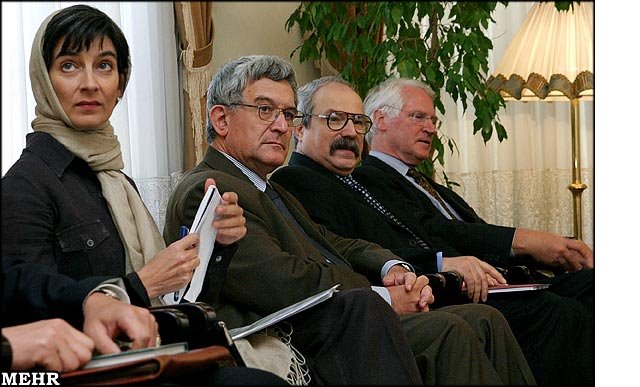
A little quiz

Wednesday, May 03, 2006
(double) Standards
A while ago, another blogger wrote about double standards, or more precisely about various interpretations depending on what suits the argument. His was in favour of the IRI. The discourse was so "nonsensical" (to use the terms of someone who responded in the comments) that my disappointment with the author led me to stop reading the blog altogether, rather than responding.
But the malaise of not having expressed my frustration remained, I guess (although I gladly found today that, in fact, someone did.)
And then, here I am, thanks to Mr. Zarif who had another go at the UN. Surely, he must feel a little awkward at calling upon the United Nations Security Council to somehow protect Iran when, a day or two before, his President had indicated that "Iran does not give a damn about such [Security Council] resolutions", and his main nuclear negotiator had defined them as "not very important".
But the malaise of not having expressed my frustration remained, I guess (although I gladly found today that, in fact, someone did.)
And then, here I am, thanks to Mr. Zarif who had another go at the UN. Surely, he must feel a little awkward at calling upon the United Nations Security Council to somehow protect Iran when, a day or two before, his President had indicated that "Iran does not give a damn about such [Security Council] resolutions", and his main nuclear negotiator had defined them as "not very important".
Saturday, April 29, 2006
O.I.D.
A couple of bloggers have recently referred to the obsession about our inalienable right (OID) that has turned into jokes, the best one so far is here, and a number of them are here.
So I thought I should add a few photos I saw yesterday, on Mr. Ahmadinejad's visit to Zanjan:
Starts with a banner, saying OID:

Then on the hills:

Then it goes a little further, as these children are saying: "An independent representative (added: to the Majlis) is OID

So I thought I should add a few photos I saw yesterday, on Mr. Ahmadinejad's visit to Zanjan:
Starts with a banner, saying OID:
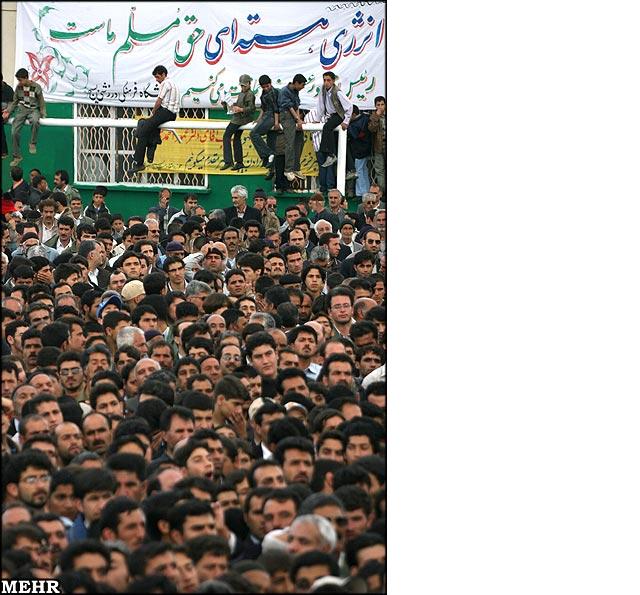
Then on the hills:
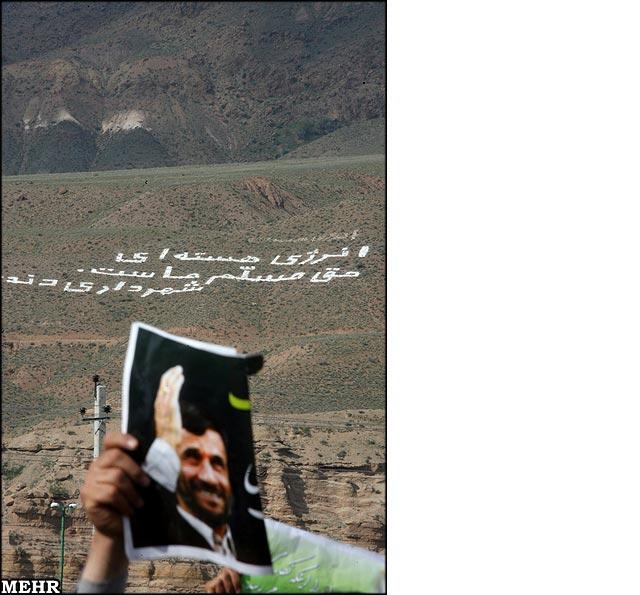
Then it goes a little further, as these children are saying: "An independent representative (added: to the Majlis) is OID
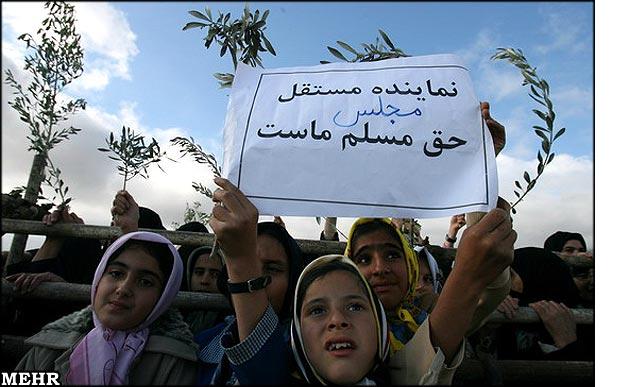
Of course, the best and funniest (and earliest) is here.
Wednesday, April 26, 2006
Douste, my friend
For the past year now, France, and particularly its Minister of Foreign Affairs, have taken a pretty strong stance on Iran. Very different from the wishy-washiness we had previously seen from them and in stark contrast with the position they held on Iraq.
The interview given to Rooz (the original French is here) is interesting because it is coming from a country that is "highly regarded" in Iran. Furthermore, Philippe Douste-Blazy himself stated that he chose the Internet media because they "have a very large audience in your country" and then went on to try to dispel some of the misinformation that is spread in the country about our "inalienable right"
And then Mr. Douste-Blazy clearly indicated that France's economic interests will not prevent it from being at the forefront of the promotion of human rights in Iran. One might be sceptical, hoping that the interview is not only lip service and that this and this will not take precedence over human rights concerns.
Let's say I have a soft spot for good-looking French doctors. However, one must admit that Douste is doing far better than one of his predecessors who, in a Op/Ed on Iran published today, together with other former FMs, indicated having "met with influential Iranian officials during the past few months" but did not even care to mention human rights...
The interview given to Rooz (the original French is here) is interesting because it is coming from a country that is "highly regarded" in Iran. Furthermore, Philippe Douste-Blazy himself stated that he chose the Internet media because they "have a very large audience in your country" and then went on to try to dispel some of the misinformation that is spread in the country about our "inalienable right"
And then Mr. Douste-Blazy clearly indicated that France's economic interests will not prevent it from being at the forefront of the promotion of human rights in Iran. One might be sceptical, hoping that the interview is not only lip service and that this and this will not take precedence over human rights concerns.
Let's say I have a soft spot for good-looking French doctors. However, one must admit that Douste is doing far better than one of his predecessors who, in a Op/Ed on Iran published today, together with other former FMs, indicated having "met with influential Iranian officials during the past few months" but did not even care to mention human rights...
Sunday, March 12, 2006
Interview with an Ayatollah
So the week-long report by the British Channel 4 in Iran has ended, and thanks to the fact that they had contacted Iranian bloggers from the outset, I watched it regularly, with some regret at first: it was a little light and never seemed to get to the real issues.
This until they went to Qom and did a programme on the power of the hozeh -- the clergy. Although the intro of Jon Snow was a little less “correct”, as he started by saying: “Iran is, in many ways an extremely controlling state. We have to ask permission for virtually everything we have to film. It's only the severity of the nuclear crisis that's persuaded the authorities here to open up as much as they have, allowing us to talk to ordinary people and those who run Iran.” I still found it very unnerving to watch the live interview of Ayatollah Mahdi Hadavi Tehrani. Particularly how pleased of himself he was, and of being on British TV!
(All day today as I read and listened to the various news about Milosevic’s death, I felt I could relate to the sense of helplessness of the victims -- that was what made me so uneasy while watching the interview.)
But ask an Iranian cleric about human rights or other religions or beliefs, and he will unfailingly give himself away: firstly, Mr. Hadavi firmly stated that human rights are implemented throughout the country, and then, when asked about the Sufis, he initially said they had done things against the regime, and then continued by declaring that it was not the government but the people who attacked them.
Earlier on he had clearly denied the fact that Iran would want to use nuclear weapons, but if this statement were to be compared to the two earlier ones, then how could one feel reassured?
This until they went to Qom and did a programme on the power of the hozeh -- the clergy. Although the intro of Jon Snow was a little less “correct”, as he started by saying: “Iran is, in many ways an extremely controlling state. We have to ask permission for virtually everything we have to film. It's only the severity of the nuclear crisis that's persuaded the authorities here to open up as much as they have, allowing us to talk to ordinary people and those who run Iran.” I still found it very unnerving to watch the live interview of Ayatollah Mahdi Hadavi Tehrani. Particularly how pleased of himself he was, and of being on British TV!
(All day today as I read and listened to the various news about Milosevic’s death, I felt I could relate to the sense of helplessness of the victims -- that was what made me so uneasy while watching the interview.)
But ask an Iranian cleric about human rights or other religions or beliefs, and he will unfailingly give himself away: firstly, Mr. Hadavi firmly stated that human rights are implemented throughout the country, and then, when asked about the Sufis, he initially said they had done things against the regime, and then continued by declaring that it was not the government but the people who attacked them.
Earlier on he had clearly denied the fact that Iran would want to use nuclear weapons, but if this statement were to be compared to the two earlier ones, then how could one feel reassured?
Thursday, March 09, 2006
In search...
We have entered a tunnel, a very dark tunnel.
These past days, all the foreign press talked about Iran, there were Op/Eds and analysis all over: The NY Times and Washington Post, Le Monde and Le Figaro, the Times, the Frankfurter, even the Corriere, to mention a few. But not one of them was able to make an innovative analysis, let alone offer the glimpse of a solution. Well, the International Crisis Group did, but frankly Derakhshan's proposal is more imaginative. I expected more from Chris Patten, but then one of their experts on the team was Tim Guldiman, known for being a proponent of compromises with Iran...
And then today I found a very interesting analysis by a Frenchman, Frédéric Tellier (from the Institut de la Recherche Stratégique) published in a Swiss newspaper, of all places! The article, entitled "L'Iran joue la carte nationaliste, qui trouve un écho dans la population" can unfortunately only be found through a search on the site of the paper, but basically, the author makes three points:
- The government in place is using Iranian nationalism (and the figure of Dr. Mossadegh) to rally a disillusioned and otherwise pro-american youth behind it. This strategy was initiated during Mr. Khatami's presidency.
- Mr. Ahmadinejad is very vocal and on the front line, but is not a main decision maker. His election was a very stategic choice by Ayatollah Khamenei, luring the West into thinking that the situation we are in now is due to Ahmadinejad's radicalism. The latter might even be used as a "fuse" in the event of a failure, to be then replaced by Rafsanjani or Khatami.
- The US military option is not impossible. Iran remains one of the main supporter of terrorism, with increasing outreach (all the way to sub-saharan Africa). Therefore a nuclear Iran is unacceptable to the West. The situation in Iraq would not be a enough of a hinderence for the US and airborne hits could be effective.
These past days, all the foreign press talked about Iran, there were Op/Eds and analysis all over: The NY Times and Washington Post, Le Monde and Le Figaro, the Times, the Frankfurter, even the Corriere, to mention a few. But not one of them was able to make an innovative analysis, let alone offer the glimpse of a solution. Well, the International Crisis Group did, but frankly Derakhshan's proposal is more imaginative. I expected more from Chris Patten, but then one of their experts on the team was Tim Guldiman, known for being a proponent of compromises with Iran...
And then today I found a very interesting analysis by a Frenchman, Frédéric Tellier (from the Institut de la Recherche Stratégique) published in a Swiss newspaper, of all places! The article, entitled "L'Iran joue la carte nationaliste, qui trouve un écho dans la population" can unfortunately only be found through a search on the site of the paper, but basically, the author makes three points:
- The government in place is using Iranian nationalism (and the figure of Dr. Mossadegh) to rally a disillusioned and otherwise pro-american youth behind it. This strategy was initiated during Mr. Khatami's presidency.
- Mr. Ahmadinejad is very vocal and on the front line, but is not a main decision maker. His election was a very stategic choice by Ayatollah Khamenei, luring the West into thinking that the situation we are in now is due to Ahmadinejad's radicalism. The latter might even be used as a "fuse" in the event of a failure, to be then replaced by Rafsanjani or Khatami.
- The US military option is not impossible. Iran remains one of the main supporter of terrorism, with increasing outreach (all the way to sub-saharan Africa). Therefore a nuclear Iran is unacceptable to the West. The situation in Iraq would not be a enough of a hinderence for the US and airborne hits could be effective.
Friday, February 17, 2006
Human or nuclear rights
Amnesty released a report on Iran at mid-day yesterday. In the opening paragraph its press release stated: "The current standoff regarding the country's nuclear programme must not distract either the government or the international community from addressing the country's long-standing human rights problems." What about the media? I watched all day yesterday, for a Reuters, perhaps an AFP ... and again today, no sign of it... Until -- finally -- it appeared on Radio Farda (I know, again, sorry, but hey…) and later on Payvand.
A few weeks ago, Mr. Ahmadinejad said (and unfortunately I am paraphrasing because I can no longer find the link) "If we solve the nuclear issue then they will come after our human rights situation.”
It’s been a while since Amnesty has written a full report on Iran. And as must be the case for all those concerned about the situation of human rights in a given country, I guess, I wish there would be more coverage about it. But the human rights discourse is no longer fashionable. We all know why too, and I will come back to this soon.
I just need to add one more point on the report: although it starts with a clear indication that the situation has worsened since the election of the new President, many of the abuses reported in there were commited during Mr. Khatami’s tenure...
A few weeks ago, Mr. Ahmadinejad said (and unfortunately I am paraphrasing because I can no longer find the link) "If we solve the nuclear issue then they will come after our human rights situation.”
It’s been a while since Amnesty has written a full report on Iran. And as must be the case for all those concerned about the situation of human rights in a given country, I guess, I wish there would be more coverage about it. But the human rights discourse is no longer fashionable. We all know why too, and I will come back to this soon.
I just need to add one more point on the report: although it starts with a clear indication that the situation has worsened since the election of the new President, many of the abuses reported in there were commited during Mr. Khatami’s tenure...
Subscribe to:
Posts (Atom)
