
There are no juvenile executions in Iran, we are just applying the law of Qisas. Implying what can we do if the families of the victims want the perpetrator to be executed?
I cannot understand why, rather than choosing to remain silent, the government of the IRI chooses to ridicule itself by saying such absurdities (scroll down to find Iran). And also to then have to hear Philip Alston (scroll down to the very end), the Special Raporteur on Summary and Arbitrary Executions, mock them even further saying: "Iran is is the only country that seems to have this problem, surely, it can find a solution." (implying there are other Islamic countries in the world).
I would not want to be an Iranian diplomat with two bits of sense and some self-respect.
Showing posts with label Islam. Show all posts
Showing posts with label Islam. Show all posts
Friday, June 05, 2009


Monday, March 30, 2009
Whisper
I went back to an old CD of mine that I love: Mohammad Reza Aligholi's Earth Whisper and particularly it's track with Rahim Moazzen Zadeh Ardabili's azan.
It is strange how the call to prayer can raise diverse feelings. A friend of mine was recently telling me how it brought back a sentiment of oppression. I remember in Sudan, where mosques were being built at literally every corner thanks to Saudi money and every morning it felt like 2-3 guys we shouting in your ears from different sides of your bed, it certainly was not spiritually uplifting.
But this one is different, and it is not only an azan:
not really a shōmyō either...
It is strange how the call to prayer can raise diverse feelings. A friend of mine was recently telling me how it brought back a sentiment of oppression. I remember in Sudan, where mosques were being built at literally every corner thanks to Saudi money and every morning it felt like 2-3 guys we shouting in your ears from different sides of your bed, it certainly was not spiritually uplifting.
But this one is different, and it is not only an azan:
not really a shōmyō either...
Sunday, March 09, 2008
Out of the Calif's chest
It seems that our Minister of Foreign Affairs has been learning melodrama: his speech, or rather the opening of his speech at the Human Rights Council last Tuesday was quite well orchestrated: he goes to the Podium, pauses, drinks a glass of water, clears his throat, straightens his goatee, pauses again, makes a reference to the heart-breaking individual case of a six-months old infant and then asks for a minute of silence.
And then he makes yet another bold move: requests that during this minute of silence Muslims in the room recite the "fatehe" and starts reciting it under his breath (and it can be slightly heard in the microphone).
(this year, the webcast is a little less practical, so to watch it, you need to go here, then choose the morning session and then go more than 3/4 into the webcast).
Perhaps he was competing with Mr. Ahmadinejad's halo a couple of years ago.
Aside from his blatant untruthfulness concerning Iran's human rights record in the rest of his speech there are a couple of points that can be raised and are a clear reflection of the behaviour of this government:
Firstly, he uses the Persian pronunciation of an Arab word, and therefore refers to "ghazzeh" (instead of Gaza), so that most people, I am sure, must have been wondering what he is talking about;
but more importantly announces that he sacrifices a minute of his speech and then speaks for 20 minutes instead of the allotted 10, thus, in fact, taking 10 minutes of the time of the following speakers.
In Persian one would say that he is making a donation out of the Caliph's chest.
Saturday, January 26, 2008
Unanswered in Davos
Mr. Khatami was once more invited to Davos for the World Economic Forum. This time he spoke at the Open Forum.
He has certainly succeeded in establishing himself as one of the darlings of the West and a kind of moderate Muslim cleric that can be talked to.
However, the most painful of all is to hear him make statements such as (I changed a little the words of the translator to make it more accurate):
"But if the intervention of religion in political life would mean to limit life, or if religion would not appreciate the human values, or would like to take away from men freedom which is one of the greatest benedictions of God, that kind of religion and interference would be a loss and the society would never accept it."
or "In the Islamic revolution people demanded freedom, independence and progress based on religion. And this is why an Islamic Republic was established. An Islamic Republic means a democratic government, where women are free, there is freedom of thought, the elections would establish the power, etc. and because people are Muslim the religious values should be present, but these religious values should not contradict these basis."
or "I don't think that in Iran anyone is prosecuted because of his religious beliefs, and if he is, this is wrong."
and that no one can (or wishes to) ask him: Mr. Khatami, you were President of Iran for 8 years, how come these lofty statements were nowhere to be implemented then?
He has certainly succeeded in establishing himself as one of the darlings of the West and a kind of moderate Muslim cleric that can be talked to.
However, the most painful of all is to hear him make statements such as (I changed a little the words of the translator to make it more accurate):
"But if the intervention of religion in political life would mean to limit life, or if religion would not appreciate the human values, or would like to take away from men freedom which is one of the greatest benedictions of God, that kind of religion and interference would be a loss and the society would never accept it."
or "In the Islamic revolution people demanded freedom, independence and progress based on religion. And this is why an Islamic Republic was established. An Islamic Republic means a democratic government, where women are free, there is freedom of thought, the elections would establish the power, etc. and because people are Muslim the religious values should be present, but these religious values should not contradict these basis."
or "I don't think that in Iran anyone is prosecuted because of his religious beliefs, and if he is, this is wrong."
and that no one can (or wishes to) ask him: Mr. Khatami, you were President of Iran for 8 years, how come these lofty statements were nowhere to be implemented then?
Wednesday, January 17, 2007
Do as I say, not as I do
I read Mr. Abtahi's post last week but did not have a chance to react before now:
Isn't it strange that the "Head of the Interreligious Dialogue Institute" does not even realize what he is writing, and that when threading on thin ice, perhaps he should watch his steps in order not to crack it.
In order to cover-up for the recent attack on Christians because they are trying to "convert" Muslims in Iran, Mr. Abtahi tells us that "the present world is the world of dialogue among religions and their cooperation", and that although it is easier for Muslims to accept Judaism and Christianity, as they existed before Islam, the Christians, thanks to the Vatican II Council, have accepted to have a dialogue and cooperate with Muslims.
With all this thirst for dialogue among religions, I think one should ask Mr. Abtahi how he feels about the Muslim accepting the Bahais, who came after Islam? And why they are not included as partners in his Institute.
Of course, he does not accept comments on his blog, but I will email him the link to this post... and will let you know if he responds.
Isn't it strange that the "Head of the Interreligious Dialogue Institute" does not even realize what he is writing, and that when threading on thin ice, perhaps he should watch his steps in order not to crack it.
In order to cover-up for the recent attack on Christians because they are trying to "convert" Muslims in Iran, Mr. Abtahi tells us that "the present world is the world of dialogue among religions and their cooperation", and that although it is easier for Muslims to accept Judaism and Christianity, as they existed before Islam, the Christians, thanks to the Vatican II Council, have accepted to have a dialogue and cooperate with Muslims.
With all this thirst for dialogue among religions, I think one should ask Mr. Abtahi how he feels about the Muslim accepting the Bahais, who came after Islam? And why they are not included as partners in his Institute.
Of course, he does not accept comments on his blog, but I will email him the link to this post... and will let you know if he responds.
Friday, July 14, 2006
(Un)veiled thoughts
As a woman not wearing the "hijab", I still respect those who, out of their own free will, wish to cover their hair/head/body in whichever manner they wish. It's their right, it's their belief. And this post contains a number of interesting links regarding the debate on this issue.
But I must say that yesterday, my heart sank when I saw this -- the First Exhibition of Islamic Covering.
Also, on the same day a Press Conference was held at the outset of the First International Conference on Women's Rights and Responsibilities in an Islamic System. The photos speak for themselves... I suggest this post be considered as a written contribution to the debate.
But I must say that yesterday, my heart sank when I saw this -- the First Exhibition of Islamic Covering.

Also, on the same day a Press Conference was held at the outset of the First International Conference on Women's Rights and Responsibilities in an Islamic System. The photos speak for themselves... I suggest this post be considered as a written contribution to the debate.
Thursday, May 18, 2006
On the fringe of "the letter"
Much has been said about "the letter". I would like to mention two: Firstly, an interesting point at the end of a New York Times article that quoted Wahid Abdel Maguid of the Egyptian Al Ahram Center for Political and Strategic Studies, saying that the letter "was addressed more to young people in the Islamic world than to the American president" (this point was subsequently repeated by others). And there was also a much-needed response to the missive, posted on a blog, which brought everything back into the right perspective.
Reading the letter, I could not but notice the amount of "(PBUH)" it contained, associated to the various prophets mentioned. Of course, Muslims are familiar with the letters in brackets that always appear after Prophet Mohammed's name, but I was wondering what Americans, and Westerners in general, would make of it.
This led me to another, perhaps more fundamental reflection: one of Mr. Ahmadinejad's points in the letter was to show his own piety and somehow prove that not only was he a fervent believer in Prophet Mohammed, but he was also knowledgeable about and respectful of the Teachings of Christ -- a claim Mr. Bush seemed to make but not put into practice. However, if one reveres the Divine Messengers, then it could indeed be a form of respect to follow the utterance of their names by the expression of the wish that peace be upon them. But then reduce this to a few letters in bracket? To me, this kills all reverence, piety and spirituality.
Reading the letter, I could not but notice the amount of "(PBUH)" it contained, associated to the various prophets mentioned. Of course, Muslims are familiar with the letters in brackets that always appear after Prophet Mohammed's name, but I was wondering what Americans, and Westerners in general, would make of it.
This led me to another, perhaps more fundamental reflection: one of Mr. Ahmadinejad's points in the letter was to show his own piety and somehow prove that not only was he a fervent believer in Prophet Mohammed, but he was also knowledgeable about and respectful of the Teachings of Christ -- a claim Mr. Bush seemed to make but not put into practice. However, if one reveres the Divine Messengers, then it could indeed be a form of respect to follow the utterance of their names by the expression of the wish that peace be upon them. But then reduce this to a few letters in bracket? To me, this kills all reverence, piety and spirituality.
Sunday, March 12, 2006
Interview with an Ayatollah
So the week-long report by the British Channel 4 in Iran has ended, and thanks to the fact that they had contacted Iranian bloggers from the outset, I watched it regularly, with some regret at first: it was a little light and never seemed to get to the real issues.
This until they went to Qom and did a programme on the power of the hozeh -- the clergy. Although the intro of Jon Snow was a little less “correct”, as he started by saying: “Iran is, in many ways an extremely controlling state. We have to ask permission for virtually everything we have to film. It's only the severity of the nuclear crisis that's persuaded the authorities here to open up as much as they have, allowing us to talk to ordinary people and those who run Iran.” I still found it very unnerving to watch the live interview of Ayatollah Mahdi Hadavi Tehrani. Particularly how pleased of himself he was, and of being on British TV!
(All day today as I read and listened to the various news about Milosevic’s death, I felt I could relate to the sense of helplessness of the victims -- that was what made me so uneasy while watching the interview.)
But ask an Iranian cleric about human rights or other religions or beliefs, and he will unfailingly give himself away: firstly, Mr. Hadavi firmly stated that human rights are implemented throughout the country, and then, when asked about the Sufis, he initially said they had done things against the regime, and then continued by declaring that it was not the government but the people who attacked them.
Earlier on he had clearly denied the fact that Iran would want to use nuclear weapons, but if this statement were to be compared to the two earlier ones, then how could one feel reassured?
This until they went to Qom and did a programme on the power of the hozeh -- the clergy. Although the intro of Jon Snow was a little less “correct”, as he started by saying: “Iran is, in many ways an extremely controlling state. We have to ask permission for virtually everything we have to film. It's only the severity of the nuclear crisis that's persuaded the authorities here to open up as much as they have, allowing us to talk to ordinary people and those who run Iran.” I still found it very unnerving to watch the live interview of Ayatollah Mahdi Hadavi Tehrani. Particularly how pleased of himself he was, and of being on British TV!
(All day today as I read and listened to the various news about Milosevic’s death, I felt I could relate to the sense of helplessness of the victims -- that was what made me so uneasy while watching the interview.)
But ask an Iranian cleric about human rights or other religions or beliefs, and he will unfailingly give himself away: firstly, Mr. Hadavi firmly stated that human rights are implemented throughout the country, and then, when asked about the Sufis, he initially said they had done things against the regime, and then continued by declaring that it was not the government but the people who attacked them.
Earlier on he had clearly denied the fact that Iran would want to use nuclear weapons, but if this statement were to be compared to the two earlier ones, then how could one feel reassured?
Tuesday, February 28, 2006
Karroubi's (recent) letter
A few days ago Mehdi Karroubi wrote an (open?) letter to the Marjaiyat, the centres of emulations, in Qom. On freedom of religion or belief...
Mr. Karroubi explicitly refers to the attack on the Sufis in Qom. However, if one reads further, it is a broader encompassing text, where he appeals to the religious leaders in Qom to protect, in conformity with the lofty principles contained in Islam, the rights of all human beings – “even those who hold beliefs that we don’t agree with"
(دفاع از حقوق همه انسانها حتی كسانی كه عقايد ايشان را نمیپسنديم)
... and hints to the fact that perhaps up to now they have rather supported those who only wear the garments of friendship.
For those who can read Persian, I recommend the whole article in Iranema.
Hmmm... probably more reason for some to feel that they have done the right thing in censoring his TV... I wonder how Iran would look like if he had come second in the first round of the elections...
Mr. Karroubi explicitly refers to the attack on the Sufis in Qom. However, if one reads further, it is a broader encompassing text, where he appeals to the religious leaders in Qom to protect, in conformity with the lofty principles contained in Islam, the rights of all human beings – “even those who hold beliefs that we don’t agree with"
(دفاع از حقوق همه انسانها حتی كسانی كه عقايد ايشان را نمیپسنديم)
... and hints to the fact that perhaps up to now they have rather supported those who only wear the garments of friendship.
For those who can read Persian, I recommend the whole article in Iranema.
Hmmm... probably more reason for some to feel that they have done the right thing in censoring his TV... I wonder how Iran would look like if he had come second in the first round of the elections...
Thursday, February 23, 2006
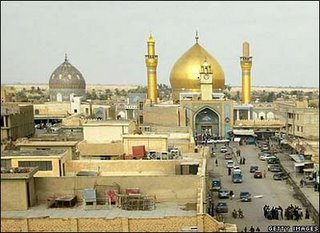
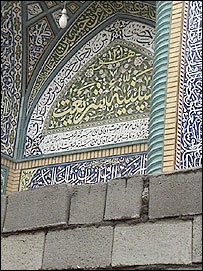
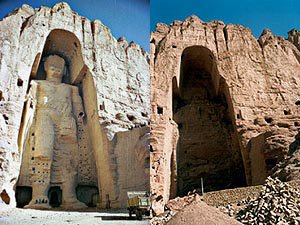
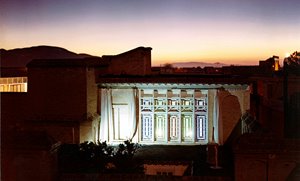
Holy Places
Samarra, sacred tombs of Imam Ali al-Hadi and Imam al-Hasan al-Askari:

Qom, Hoseynieh of the Sufis:
Bamiyan, Statues of the Buddha:
Shiraz, House of the Bab:


Qom, Hoseynieh of the Sufis:

Bamiyan, Statues of the Buddha:

Shiraz, House of the Bab:


Friday, February 10, 2006
Shajarian v/ Touré
Weren't we all excited when Mohammad Reza Shajarian (together with Hossein Alizadeh, Kayhan Kalhor and Homayoun Shajarian) was nominated for the Grammy awards. Of course, they had been nominated the year before last as well -- the more reason to hope that they would receive the prize this year! And the "Saz va Avaze Abu Ata" on the second CD of Faryad is just unbelievably soul stirring.
But then, who else was nominated ... Ali Farka Touré ... probably the greatest African musician alive, in collaboration with the griot Toumani Diabate. Very different dialogues between the men and the instruments and yet, equally as mesmerizing.
When I think of the opposition and similarities between the music of Shajarian and that of Touré it reminds me of the two architectural masterpieces: the mosques in Isfahan and Timbuktu.
But then, who else was nominated ... Ali Farka Touré ... probably the greatest African musician alive, in collaboration with the griot Toumani Diabate. Very different dialogues between the men and the instruments and yet, equally as mesmerizing.
When I think of the opposition and similarities between the music of Shajarian and that of Touré it reminds me of the two architectural masterpieces: the mosques in Isfahan and Timbuktu.
Thursday, February 09, 2006
More about the cartoons
I thought I was done with the subject of the cartoons, but then first came that so very UNee statement by three UN Special Rapporteurs, on contemporary forms of racism, on freedom of religion or belief and on freedom of opinion and expression. From what I understand they (and their staff at the Office of the High Commissioner for Human Rights) had agonized about it for nearly a week! They are treading a very fine line -- it is not for me to criticize.
As much as the previous days had been rather distressing and gloomy, I started to read Brooding Persian's post, qualified by "Psychic" as "brilliant"-- and I fully agree (sorry Psychic, you left no trace, so no possible link on my part). And the day became even brighter as I read in Le Monde the opinion of Soheib Bencheikh, the very enlightened former Mufti of Marseille and that of Mona Eltahawy's in the IHT.
As much as the previous days had been rather distressing and gloomy, I started to read Brooding Persian's post, qualified by "Psychic" as "brilliant"-- and I fully agree (sorry Psychic, you left no trace, so no possible link on my part). And the day became even brighter as I read in Le Monde the opinion of Soheib Bencheikh, the very enlightened former Mufti of Marseille and that of Mona Eltahawy's in the IHT.
Wednesday, February 08, 2006
Defamation
It is impossible not to read about the cartoons.
I wanted to post an appeal by Tewfik Allal, from the "Association du Manifeste des libertés", but could not find the link.
The three articles that are still remembered by my faulty brain are Thomas Kleine-Brockhoff in the Washington Post, and for those who read Persian, Nikahang's post and French, Olivier Roy's in Le Monde.
What comes to mind first and foremost is the issue that seems to be otherwise obliterated: why is it that it is OK for papers in Saudi Arabia to publish cartoons of Jews drinking children's blood, for TV series in Egypt to bring out the old story of the protocol of the Elders of Zion, for Kayhan to print ad nauseum that Baha'is are creations of the British, Zionism and all the ills of the world and yet when it comes to those Danes...
The OIC has made it a specialty lately to infuse the UN with cries about the defamation of Islam. All religions and beliefs should be respected and I too find it offensive to trample on what is most sacred for others (or for myself). Yet, first and foremost, shouldn't there be a principle of reciprocity?
I wanted to post an appeal by Tewfik Allal, from the "Association du Manifeste des libertés", but could not find the link.
The three articles that are still remembered by my faulty brain are Thomas Kleine-Brockhoff in the Washington Post, and for those who read Persian, Nikahang's post and French, Olivier Roy's in Le Monde.
What comes to mind first and foremost is the issue that seems to be otherwise obliterated: why is it that it is OK for papers in Saudi Arabia to publish cartoons of Jews drinking children's blood, for TV series in Egypt to bring out the old story of the protocol of the Elders of Zion, for Kayhan to print ad nauseum that Baha'is are creations of the British, Zionism and all the ills of the world and yet when it comes to those Danes...
The OIC has made it a specialty lately to infuse the UN with cries about the defamation of Islam. All religions and beliefs should be respected and I too find it offensive to trample on what is most sacred for others (or for myself). Yet, first and foremost, shouldn't there be a principle of reciprocity?
Subscribe to:
Posts (Atom)